
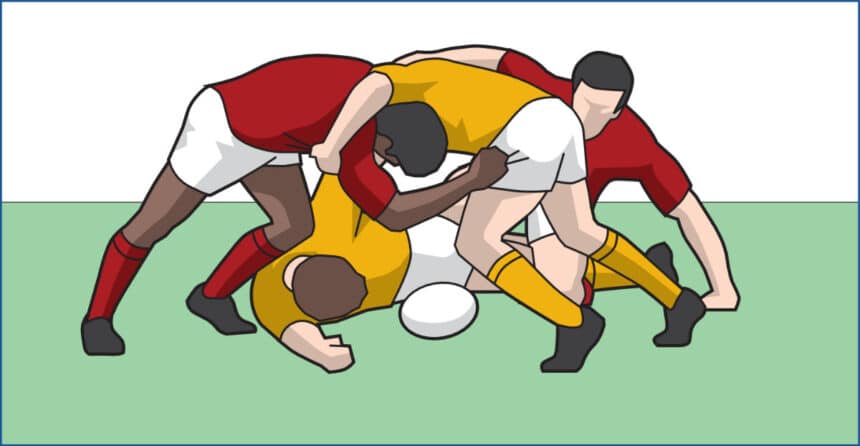

A ruck is one of the most fundamental aspects of rugby union, occurring countless times during every match. Understanding rucks is essential for appreciating how rugby flows and why certain tactics work.
Basic Definition
A ruck forms when the ball is on the ground and one or more players from each team close over it while on their feet. The ball must be available to be played, and players compete for possession by driving over the ball rather than handling it.
How a Ruck Forms
The Sequence
- Ball Carrier Goes to Ground: A player is tackled and brought to ground while holding the ball
- Ball Placement: The tackled player must immediately release the ball and roll away
- Arrival of Support: Players from both teams arrive to contest possession
- Ruck Formation: Once one player from each team engages over the ball, a ruck is formed
Key Trigger Points
- Ball must be on the ground
- At least one player from each team must be bound over the ball
- Players must be on their feet and driving forward
- The ball must be contested (if uncontested, it remains a tackle situation)

Essential Ruck Laws
For All Players
- Stay on feet: Players must remain upright throughout the ruck
- Enter from behind: Must join through the “gate” (behind the hindmost foot of your team)
- Bind properly: Must bind onto a teammate, not just lean or place hands on them
- No hands: Once the ruck forms, only feet can be used to play the ball
For the Tackled Player
- Release immediately: Must let go of the ball as soon as tackled
- Roll away: Must move away from the ball as quickly as possible
- Can’t play ball: Cannot interfere with the ball once released
For the Tackler
- Release tackled player: Must let go before attempting to play ball
- Get to feet: Must stand up before competing for possession
- Roll away: If unable to compete, must move away from the ruck area
Ruck Strategy and Tactics
Attacking Team
- Quick Ball: Commit enough players to secure possession quickly
- Clean Out: Drive defending players away from the ball
- Platform Creation: Establish stable possession for next phase
- Numbers Game: Usually commit 1-2 players minimum
Defending Team
- Contest or Retreat: Decide whether to compete or set defensive line
- Jackaling: Single player attempts to win turnover by getting hands on ball
- Slowing Ball: Legal methods to delay opposition’s ball
- Counter-Rucking: Drive through to win possession
Common Ruck Infractions
Major Penalties
- Not releasing: Tackled player or tackler doesn’t release
- Not rolling away: Players blocking the ball illegally
- Offside: Joining ruck from the side or in front of offside line
- Hands in ruck: Playing ball with hands once ruck formed
- Off feet: Players going to ground or not supporting body weight
Technical Violations
- Sealing off: Deliberately blocking access to the ball
- Collapsing: Intentionally bringing down ruck
- Obstruction: Preventing opponents from joining legally
The Offside Lines
Crucial Concept
- Imaginary line: Runs through hindmost foot of each team in ruck
- Player positioning: All players must stay behind their team’s offside line
- Exception: Players in the ruck itself
- Reset: Lines move as players join or leave ruck
Referee Management
Communication
- “Ruck formed”: Referee calls when ruck officially exists
- “Ball available”: Scrum-half can play the ball
- “Use it”: Instruction to play ball or lose possession
- Penalty calls: Clear indication of infractions
Why Rucks Matter
Game Flow
- Continuity: Allow rugby to flow between phases
- Possession battle: Key contest areas throughout match
- Territory gain: Platform for advancing up field
- Set piece creation: Can lead to scrums when ball unplayable
Tactical Importance
- Resource allocation: Teams must balance committing players vs keeping them available
- Tempo control: Fast ruck ball enables attacking opportunities
- Defensive organization: Time for defensive lines to reset
- Turnover opportunities: Key moments to regain possession
Key Differences from Mauls
Ruck: Ball on ground, players drive over it with feet Maul: Ball carrier remains standing, bound by teammates and opponents
Modern Ruck Evolution
The ruck has evolved significantly in professional rugby:
- Speed emphasis: Faster ball recycling is prioritized
- Jackaling specialists: Players who excel at winning turnovers
- Technical precision: Referee interpretation has become more detailed
- Tactical complexity: Sophisticated decision-making about when to compete
Tips for Understanding Rucks
When Watching Rugby
- Look for the ball: Focus on where it is on the ground
- Count players: Notice how many each team commits
- Watch the referee: Listen for their calls about ruck formation
- Observe entry angles: See how players join from behind
Key Indicators
- Clean ball: Smooth, fast delivery to scrum-half
- Messy ball: Slow, contested possession
- Turnover: When defending team wins the ball
- Penalty: When laws are broken
Understanding rucks is essential for appreciating rugby’s unique blend of individual skill and team coordination. They represent the constant battle for possession that makes rugby such a compelling and tactical sport.
A ruck is formed when the ball is on the ground and one or more players from each team close over it while remaining on their feet. Players compete for the ball using only their feet, not their hands.
A ruck forms when at least one player from each team engages over the ball on the ground. Until this happens, it’s considered a tackle situation where different rules apply.
Tackle: One-on-one situation where the ball carrier is brought to ground
Ruck: Multiple players from both teams contest the ball after a tackle, with the ball on the ground
Players must join a ruck from behind the hindmost foot of their own team. The “gate” is the imaginary corridor directly behind your team’s players. Entering from the side is offside.
Jackaling is when a player arrives first at a tackle and attempts to win the ball by placing their hands on it before a ruck forms. They must remain on their feet and not be driven off by opponents.


