

The lock position represents the engine room of any successful rugby team. These towering athletes must dominate lineouts, provide grunt work in the tight exchanges, and offer leadership that anchors the forward pack. The number four jersey traditionally belongs to one of two locks who form the backbone of scrums and mauls while contributing heavily to a team’s physicality and set-piece success. As we assess the elite second-rowers currently operating at international level, several players have distinguished themselves through sustained excellence and match-winning performances.
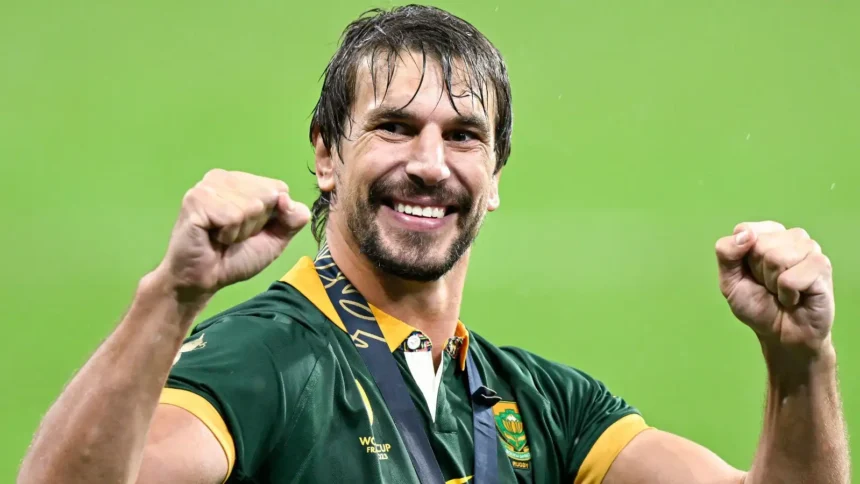
#1 Eben Etzebeth (South Africa)
The Springbok colossus stands as the benchmark for lock play in world rugby. Etzebeth’s combination of size, athleticism, and technical proficiency makes him virtually unmatched in the modern game. Standing at 6’8″ and weighing over 120 kilograms, he brings an imposing physical presence that intimidates opponents while inspiring teammates.
Etzebeth’s lineout work is exceptional, functioning as a primary target with reliable hands and excellent timing. His scrummaging provides a solid platform for the Springbok pack, while his ability to carry in tight channels creates crucial go-forward momentum. Defensively, he’s a dominant tackler who rarely misses and often drives ball carriers backward.
What truly elevates Etzebeth above his peers is his durability and consistency. With over 120 Test caps and multiple Rugby World Cup campaigns, he continues performing at an elite level year after year. His leadership qualities and on-field communication make him the cornerstone of South Africa’s forward dominance.
#2 Tadhg Beirne (Ireland)
Ireland’s versatile forward has established himself as one of the most complete locks in international rugby. Beirne’s technical expertise at the breakdown sets him apart from traditional second-rowers, regularly winning turnovers that other locks wouldn’t contest. His ability to play across the second and back rows gives Ireland valuable tactical flexibility.
Beirne’s lineout work is outstanding, functioning as both jumper and lifter with equal proficiency. His rugby intelligence allows him to read opposition throws and disrupt their set piece. The Munster star also contributes significantly in attack, with excellent handling skills and support play that create opportunities for teammates.
His work rate is phenomenal, appearing in wide channels to make tackles and support ball carriers with the frequency of a flanker. Beirne’s consistency across multiple competitions and his ability to perform in crucial matches make him indispensable to Ireland’s success. His partnership with other Irish locks provides the foundation for their forward dominance.
#3 Maro Itoje (England)
England’s talismanic lock brings intensity and intelligence that few can match. Itoje’s athleticism allows him to cover ground like a back-rower while maintaining the physicality expected of a world-class lock. His lineout work remains exceptional, with his athleticism and timing making him a reliable target in any situation.
What distinguishes Itoje is his disruptive ability. He harasses opponents at every phase, slowing ball, competing at breakdowns, and creating chaos in opposition attacks. His communication and leadership qualities have made him a cornerstone of England’s pack, organizing defensive lines and lifting standards through his relentless effort.
Itoje’s experience with the British and Irish Lions, including multiple Test appearances, demonstrates his ability to perform at the highest level. The Saracens lock has been at the forefront of English rugby for nearly a decade, consistently delivering performances that influence tight matches. His competitive edge and refusal to accept defeat inspire those around him.
#4 Brodie Retallick (New Zealand)
The two-time World Rugby Player of the Year continues to define excellence in the second row. Retallick’s unique skill set combines traditional lock attributes with exceptional ball-handling and support play. His ability to offload in contact and create attacking opportunities separates him from conventional locks.
Retallick’s lineout work is world-class, with his timing and jumping ability making him a primary target throughout his career. His scrummaging provides a solid foundation for the All Blacks, while his work around the field rivals many flankers. The Chiefs star regularly appears in wide channels, making tackles and supporting attacks.
At 33, Retallick’s experience and rugby intelligence compensate for any marginal decline in athleticism. His partnership with other All Blacks locks has been central to New Zealand’s forward success over the past decade. His ability to read the game and make crucial interventions in pressure situations remains as sharp as ever.
#5 Will Skelton (Australia)
The Australian giant brings unprecedented size to the lock position, standing at 6’8″ and weighing approximately 140 kilograms. Skelton’s physical presence alone creates problems for opposition defenses, requiring multiple tacklers to bring him down. His ball-carrying in tight channels generates crucial meters and creates quick ball for the Wallabies.
Skelton’s scrummaging provides enormous power, anchoring the Australian pack and creating a stable platform. His lineout work has improved significantly throughout his career, transforming from a weakness into a reliable asset. The La Rochelle star’s ability to dominate mauls makes him invaluable in both attacking and defensive situations.
His impact off the bench or as a starter changes games. Skelton’s combination with other Australian locks gives the Wallabies genuine physical presence in the tight exchanges. While his mobility may not match smaller locks, his power and intimidation factor create unique tactical opportunities.
#6 Tadhg Furlong (Ireland)
While primarily recognized as a tighthead prop, Furlong’s versatility and importance to Irish rugby warrant recognition. His technical proficiency in the scrum is world-class, consistently dominating international opposition and providing a stable platform. Furlong’s ability to play extended minutes while maintaining effectiveness sets him apart.
His work around the field resembles a lock more than a traditional prop. Furlong regularly makes tackles in wide channels, provides excellent support play, and demonstrates handling skills that create attacking opportunities. His rugby intelligence and decision-making under pressure make him one of Ireland’s most important forwards.
The Leinster star’s consistency across multiple seasons and his ability to perform in crucial matches have made him indispensable. His leadership qualities and communication skills help organize the Irish forward pack. Furlong’s durability and sustained excellence mark him as one of the modern game’s finest tight forwards.
#7 RG Snyman (Ireland)
The South African-born lock has brought his considerable talents to Irish rugby, adding another dimension to their forward pack. Snyman’s athleticism and mobility for a player of his size are remarkable, regularly covering ground and making tackles across the field. His lineout work is exceptional, functioning as a primary target with reliable hands.
Snyman’s ball-carrying creates problems for defenses, with his combination of size and footwork allowing him to beat defenders in tight spaces. His offloading ability adds an attacking threat that few locks possess. The Munster star’s breakdown work is also impressive, competing for turnovers with flanker-like intensity.
Injuries have occasionally interrupted his career, but when fit, Snyman performs at the highest level. His partnership with other Irish locks provides tactical flexibility and genuine competition for places. His experience winning the Rugby World Cup with South Africa brings invaluable knowledge to Ireland’s forward pack.
#8 Cameron Woki (France)
France’s versatile forward excels across the second and back rows, bringing athleticism and skill that define modern French rugby. Woki’s pace and agility for a lock are exceptional, allowing him to cover ground and make tackles that other second-rowers cannot reach. His lineout work is reliable, with excellent timing and jumping ability.
Woki’s ball-carrying combines power with footwork, regularly breaking tackles and generating quick ball. His offloading ability creates attacking opportunities, while his support play demonstrates excellent rugby intelligence. The Racing 92 star’s defensive work is aggressive, with his tackle technique forcing turnovers and disrupting attacks.
His ability to play multiple positions gives France valuable tactical options, whether starting or impacting games from the bench. Woki’s youth and potential suggest his best rugby lies ahead, though he already performs at world-class level. His versatility and athleticism represent the evolution of lock play in modern rugby.
#9 Scott Barrett (New Zealand)
The All Blacks captain brings leadership and technical excellence to the lock position. Barrett’s lineout work is world-class, functioning as a primary caller and jumper with exceptional reliability. His scrummaging provides a solid foundation, while his work around the field demonstrates excellent fitness and commitment.
Barrett’s defensive game is built on intelligent positioning and effective tackling. He regularly makes crucial interventions that halt opposition momentum, while his breakdown work adds another dimension to his game. The Crusaders star’s ball-carrying has improved significantly, now presenting a genuine attacking threat in tight channels.
His captaincy has developed impressively, guiding the All Blacks through challenging periods with maturity and composure. Barrett’s ability to read the game and communicate tactical adjustments makes him invaluable beyond his individual statistics. His consistency and leadership mark him as one of New Zealand’s most important forwards.
#10 Joe Launchbury (England)
The veteran English lock continues to deliver consistent performances built on technical excellence and high work rate. Launchbury’s lineout work is reliable, with his experience allowing him to read opposition throws and disrupt their set piece. His scrummaging provides solid foundations, while his defensive game remains rock-solid.
What distinguishes Launchbury is his tackle count and defensive organization. He regularly leads England in tackles made, with his technique and positioning setting standards for the pack. His work rate around the field is relentless, appearing at breakdowns and supporting teammates throughout matches.
While he may not possess the athleticism of younger locks, Launchbury’s experience and rugby intelligence compensate. His leadership qualities and communication skills help organize England’s defensive structure. The Harlequins star’s professionalism and consistency make him a valuable squad member who can be relied upon in crucial situations.
The Modern Lock Requirements
Today’s elite locks must be complete players who contribute across all phases. Set-piece excellence remains fundamental, with lineout expertise and scrummaging power forming the foundation of their value. However, the modern game demands much more from second-rowers.
Mobility and work rate have become increasingly important. Top locks must make tackles across the field, support attacks in wide channels, and contest breakdowns with flanker-like intensity. Ball-carrying ability creates go-forward momentum, while handling skills and offloading add attacking dimensions.
Leadership qualities are often essential, with many locks captaining their teams or providing vocal organization in the pack. Communication skills help coordinate defensive lines and set-piece execution. The ability to perform consistently over 80 minutes while maintaining physical intensity separates elite locks from the rest.
Physical size remains important, but athleticism and technical skill have become equally valued. The best locks combine traditional attributes with modern requirements, creating complete players who influence games across multiple areas. As rugby continues evolving, these athletes define what it means to wear the number four jersey at the highest level.


